
The US Food and Drug Administration issued an alert to healthcare professionals of a change in heparin manufacturing that is expected to decrease the drug's potency.
The US Food and Drug Administration issued an alert to healthcare professionals of a change in heparin manufacturing that is expected to decrease the drug's potency.
Also, FDA partners with USDA on produce safety, and the Transparency Task Force announces its second public meeting...
The US Food and Drug Administration published its first draft guidance for industry about Risk Evaluation and Mitigation Strategies (REMS) on Sept. 30, 2009.
Company and People Notes: GSK forms joint venture with China-based Jiangsu Walvax Biotech; Sigma-Aldrich appoints VP and board member; more...
AAPS President offers hope and solutions for the industry's challenging future.

Is the square root of (N) + 1 a statistically valid scheme?

Pharmaceutical companies in India have had a hold on the biotechnology sector for many years, and they're not about to let the follow-on biologics market pass them by.

The countries of Central and Eastern Europe and the Commonwealth of Independent States are closing in on global pharmaceutical competition.

Strict enforcement, new rules, and organizational changes signal an activist tone.
The authors relay the outcome of a two-day workshop that brought together regulators and generic-drug industry representatives.

Industry, equipment vendors, and regulators are busy refining the precision and reliability of dissolution testing.

BIO supports recent Congressional action toward a 12-year data exclusivity period for innovators.
Like life, the workplace also can have many surprises.
FDA has been encouraging drug sponsors to use a systematic approach such as quality-by-design principles for pharmaceutical development.
Representatives of one pilot program participant, Wyeth, outline the experiences and lessons learned for implementing a science- and risk-based approach to drug-development and manufacturing.

The author discusses control strategies via near infrared instrumentation for continuous mixing, granulation, drying, and extrusion with a more focused detail on mixing.
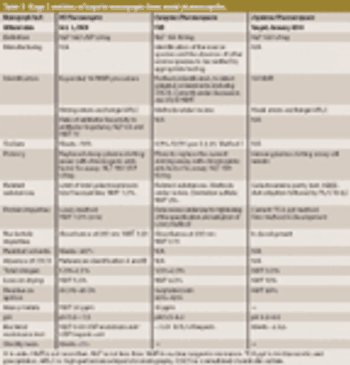
USP workshop participants support new methods to safeguard heparin products but desire international harmonization. This article contains bonus online-exclusive material.
The EMEA intends to fully implement its Product Information Management (PIM) approach, an initiative designed to improve information management, into the centralized procedure within 2 years, according to a statement of intent from the agency.
A review of NIPTE's core projects and its plans for training-and retraining-the pharmaceutical industry.
The FDA issued a proposed rule to clarify the cGMP requirements applicable to combination products in the Federal Register.
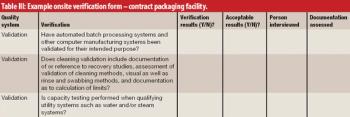
This article introduces the "Q.U.E.S.T." approach for vendor qualification, a practical and compliant methodology for pharmaceutical and biopharmaceutical companies to qualify vendors and hence make well-informed purchasing-related decisions.
As the pharmaceutical industry moves further into Central and Eastern Europe and the Commonwealth of Independent States, several standard-setting and regulatory bodies are also increasing collaboration in the region, particularly in Russia.
The author describes the framework needed to implement QbD and achieve the deeper process understanding that is fundamental to QbD.

Pharmaceutical companies get ideas for sustainable packaging from other industries.
The author analyzes, from an agency perspective, whether question-based review has improved product quality or made the review process easier for regulators or for industry.