
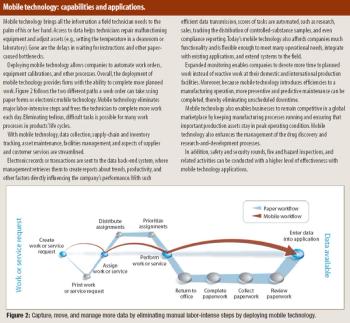
Seven Reasons Why Pharmaceutical Makers Are Adopting Mobile Technology
The evolution of therapeutic modalities drives the adoption of single-use technologies.

Despite its understandable hesitancy, the pharma industry is facing a need for more widespread adoption of cloud-based solutions.

Given the criticality of fill/finish processes, it is clear that automation is the next technological step.

Seven Reasons Why Pharmaceutical Makers Are Adopting Mobile Technology

The pharmaceutical market is undergoing a major transformation with companies moving more and more toward the generics business, according to a new report.
After a whirlwind of negative press this fall regarding the safety of cough and cold medications for children under age 6, the US Food and Drug Administration?s Nonprescription Drugs and Pediatric Advisory Committees have recommended such over-the-counter drugs no longer be used for young children.
Company and People Notes: ImClone, BMS, and Merck form agreement; CRI Worldwide names new CEO, more.
Medical students are participating in various activities this week to persuade medical schools to shield their campuses from the influence of pharmaceutical marketing as part of ?National PharmFree Week.?
Under a new US Food and Drug Administration revision, sole manufacturers of drugs considered life-supporting, life-sustaining, or for prevention of certain serious diseases or conditions will be required to notify FDA at least six months before discontinuing production of the product.
On behalf of manufacturers of over-the-counter (OTC) infant cough and cold medications, the Consumer Healthcare Products Association announced a voluntary withdrawal of products intended for use in children under age 2.
The US Food and Drug Administration sent Med-South Pharmacy a Warning Letter for producing large volumes of betamethasone acetate?betamethasone sodium phosphate without following current good manufacturing practices (CGMPs).
Company and People Notes: Orexo acquires Biolipox, Avalon cofounder resigns, more...
The collaboration of two companies will mean the process-scale implementation of an innovative technique for creating complex proteins from moss cells.
A researcher at the University of Wolverhampton (UK) has won a prestigious award for her work in predicting the shelf life of medicines.
Demand for the new cost and time-reducing technology, unveiled by Avecia Biologics in May this year, has seen the company invest more than ?1 million.
CPhI Worldwide, the large trade show of suppliers of active pharmaceutical ingredients (APIs), intermediates, and excipients, took on a decidedly international presence.
The US Food and Drug Adminstration?s Center for Biologics Evaluation and Research has issued a Warning Letter to Genzyme Corporation.
Company and People Notes: Novartis and MIT to study continuous processing, GSK appoints Andrew Witty as CEO, more.
The US Food and Drug Administration will hold a public meeting on November 14, 2007 to solicit comments about the proposed behind-the-counter (BTC) availability of drugs.

Contract manufacturers slim down to improve profitability.
Cardinal Health began construction on a $50 million expansion of its headquarters in Dublin, Ohio, on Oct. 3, 2007.
Ranbaxy received full market approval from the US Food and Drug Admnistration for its anti-infective agent ?Clarithromycin? oral suspension.
Company and People Notes: Thermo Fisher Scientific buys Priority Solutions International, Wyeth elects new president and CEO, more.
Transdermal delivery takes up once-forbidden compounds, reviving markets and creating formulation opportunities.

Change is inevitable, as is contract manufacturing. But which companies will survive the drifts?

Carl Zeiss MicroImaging (Thornwood, NY) recently introduced its "Colibri" light-emitting diode (LED) light source for fluorescence microscopy. The product is "the only LED light source optimized for white-field microscopy systems," says Becky Homan, product manager for biomedical light microscopy.

Amidst debate, the European Pharmacopoeia Commission is working to include physical or "functionality-related characteristics" of exipient materials in its monographs.

When it comes to designing and sourcing sustainable packaging, there are no simple answers. Sustainable packaging depends on a complex interaction of environmental, social, and economic considerations, which are influenced by geography and other factors such as renewability, compostability, biodegradability, weight, and performance.