


FDA readies more efficient oversight processes while advancing collaboration with Europe.
FDA readies more efficient oversight processes while advancing collaboration with Europe.
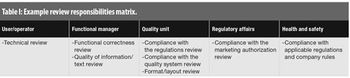
It is good industry practice to clarify the precise remit for each of the reviewers of a controlled document, says Siegfried Schmitt, PhD, vice-president, technical, Parexel Consulting.

Unforeseen challenges can be avoided in technology transfer by evaluating the variety of processes involved.
A recent report released by an FDA task force highlights the financial, manufacturing, and policy issues underlying the drug shortages of important prescription medicines in the United States.
The successful inspection comes after the facility passed a pre-approval inspection in June 2019 from Japan’s Pharmaceutical and Medical Device Agency for an innovative drug.
The company is recalling Alprazolam Tablets, USP C-IV 0.5 mg because of potential presence of foreign substance.
The agency’s implementation of the SUPPORT Act has included new guidance documents and actions to restrict illicit drugs entering the US.
Pfizer has issued a voluntary recall of batches of its docetaxel injection 80 mg/8 mL due to impurity concerns.
Dr. Reddy’s, Sanofi, and Perrigo Company issued voluntary recalls of ranitidine in October 2019 because of N-Nitrosodimethylamine contamination.
Improving operator skills using flexible, online training benefits pharmaceutical tableting operations.
The agency announced it has approved 1171 generic drugs in fiscal year 2019.
The guidance document discusses the preparation and submitting of drug master files as well as FDA’s review process.
The guidance discuses waivers, refunds, and reductions of user fees under sections 735 and 736 of the FD&C Act.
Over a two-year period, FDA inspections at company facilities found repeat problems with quality systems including lack of written procedures, inadequate investigation of out-of-specification conditions and corrective and preventive action, and insufficient cleaning and cleaning validation.
Sarah Hardison, head of Regulatory and Pharmacovigilance Solutions, Clarivate Analytics, will regulatory tackle trends in her presentation on the World of Pharma Podium during the second day of CPhI Worldwide.
Emphasizing the need for senior management to take cGMP compliance seriously, the agency pointed to “improvisational” validation procedures, lack of compliance with written procedures, as well as inadequate process control, root cause analysis, and corrective and preventive action (CAPA) in its warning letter.
Innoveix Pharmaceuticals, Inc. is voluntarily recalling all sterile compounded drug products due to a lack of assurance of sterility.
The guidance describes an optional streamlined submission process for use of an investigational in vitro diagnostic in a clinical trial for oncology therapies.
AstraZeneca received approval from FDA for Fasenra Pen, a pre-fillled auto-injector pen that allows for self-administration of its asthma biologic therapy, Fasenra (benralizumab).
In an Oct. 10, 2019 press release, ChargePoint Technology announced that its smart monitoring system, Verifi, is now available for the biopharma market.
The root cause of NDMA contamination may go well beyond manufacturing problems, to the molecule itself.
FDA and DEA warn four website operators to stop illegally selling opioids.
Climbing out of a reputation hole starts with adopting a quality culture.
A new European Commission is likely, with the support of a new European Parliament, to give a higher profile to healthcare and pharmaceutical matters during its five years in office.
Falsified documents and manipulated test results prompt warnings and investigations.