


Pharmaceutical science & technology news.
Pharmaceutical science & technology news.
The authors describe the solicitation of industry input for the guidance through a process that included a 2002 meeting of the Advisory Committe on Pharmaceutical Science and the subsequent formation of the PQRI Aseptic Processing Working Group.
Europe's pharmaceutical R&D has recently come under a barrage of criticism. Nobel laureate, Kary Mullis, highlighted the issue of over-legislating biotechnology and the business industry expressed its dismay concerning the EU's overly cautious approach to any kind of development. Action is needed before the sector's future resembles the plot of a Shakespearean tragedy.

For nearly 40 years, drug dossiers have supported the quality, safety and risk/benefits of medicinal products. However, electronic technological advances mean that the dossier will soon be a thing of the past - being replaced by e-documents that can be reviewed and approved online by regulators, under the scrutiny of patient groups and with the final blessing of purchasers, as this article examines.
Regular update from Washington.

On 20 February 2003, the US Food and Drug Administration (FDA) published a new draft guidance relating to 21 CFR Part 11. The new guidance mainly affects the compliance requirements of systems with a low risk and low impact on product quality; however, systems with a high risk and high impact on product quality, such as chromatography data systems or laboratory information management systems (LIMS), remain unaffected, as this article describes.
Pharmaceutical science & technology news.
FDA's newly launched risk-based approach to GMP regulation spurs signficant changes in the agency's approach to inspection processes, postapproval changes, and 21 CFR Part 11 enforcement.
The US Food and Drug Administration is making changes in inspection processes, post-approval manufacturing changes and 21 CFR Part 11 policies to streamline oversight and improve product quality.

During autumn 2001, a Delphi survey was conducted using the Internet to discover the opinions of European experts from the pharmaceutical fields of industry, regulation and academia regarding pharmaceutical process validation. The Internet Delphi method was found to be an appropriate tool for exploring the opinions and experiences of pharmaceutical manufacturing because it allowed anonymous participation and discussion between geographically dispersed parties. However, to obtain reliable results, many factors were taken into account, as this article examines.
By its own admission, as the European Union tries to keep pharmaceutical and biotechnology development moving in the right direction, things are not going exactly to plan. With companies cancelling research projects at an alarming rate, it is politics, yet again, that is clouding the main issues of research and financial resources. And increasing pressure from the US isn't making life easier.

The pressure on the pharmaceutical industry to manufacture products faster and more cost-effectively has never been greater. Additionally, companies must also meet stringent regulations set by authorities such as the US Food and Drug Administration (FDA) and the European Agency for the Evaluation of Medicinal Products (EMEA). This article explores the importance of complying with regulations and validation, how to maintain compliance and looks at some of the consequences of non-compliance.
Concerns about the safety and efficacy of dietary and herbal products are generating manufacturing requirements and analytical standards for ingredients.
Pharmaceutical science & technology news.
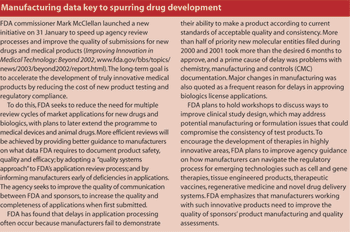
As the US Food and Drug Administration (FDA) strives to streamline its regulatory process for bringing new drugs to market (see sidebar "Manufacturing data key to spurring drug development"), efforts to ensure the quality, safety and efficacy of dietary supplements and herbal medicines are gaining more attention.
Brussels report

The renewal of European regulations regarding pharmaceutical process validation in autumn 2001 has been the subject of much discussion. The purpose of this article is to summarize and review the development of pharmaceutical process validation, and demonstrate how industry opinion regarding the concept has shifted from that of a regulatory burden to something driving total quality management and cost benefits.
Health experts are recognizing teh need to plan for global manufacturing of new treatments for AIDS and other diseases.
Pharmaceutical science & technology news.
Analytical methods development and validation play important roles in the discovery, development, and manufacture of pharmaceuticals. The official test methods that result from these processes are used by quality control laboratories to ensure the identity, purity, potency, and performance of drug products.
Brussels report
Progress in developing AIDS vaccines is focussing attention on the challenges involved in producing millions of doses for developing nations.
Bridging the gap between compliant spreadsheet production and limitations in available technology can be achieved by the use of custom-created electronic solutions.
A procedures system must be well designed and managed to be effective and efficient.